How Multiple Voices Can Think Together

A thought on its own can be rigorous, erudite, brilliant. It can sustain a long line of reasoning, develop complex argumentation, anticipate objections, and refine its own formulations. But there is one thing it cannot do: test its own solidity. A consciousness that examines itself alone only examines what it allows itself to examine. The presuppositions that structure its reasoning without its awareness remain invisible to it. The axioms it takes as self-evident will appear self-evident throughout the examination. Blind spots cannot be identified from the angle that produces them.

That is why thought needs other voices. Not merely out of civility, nor simply to confront its conclusions with an audience — but because the very quality of its operation demands an alterity capable of resisting it, responding to it, and holding it to account. A thought sharpened through contact with another is not the same thought as one that unfolds without a counterpart. It has a different consistency. That difference is not marginal: it touches what distinguishes a living thought from a merely formal one.

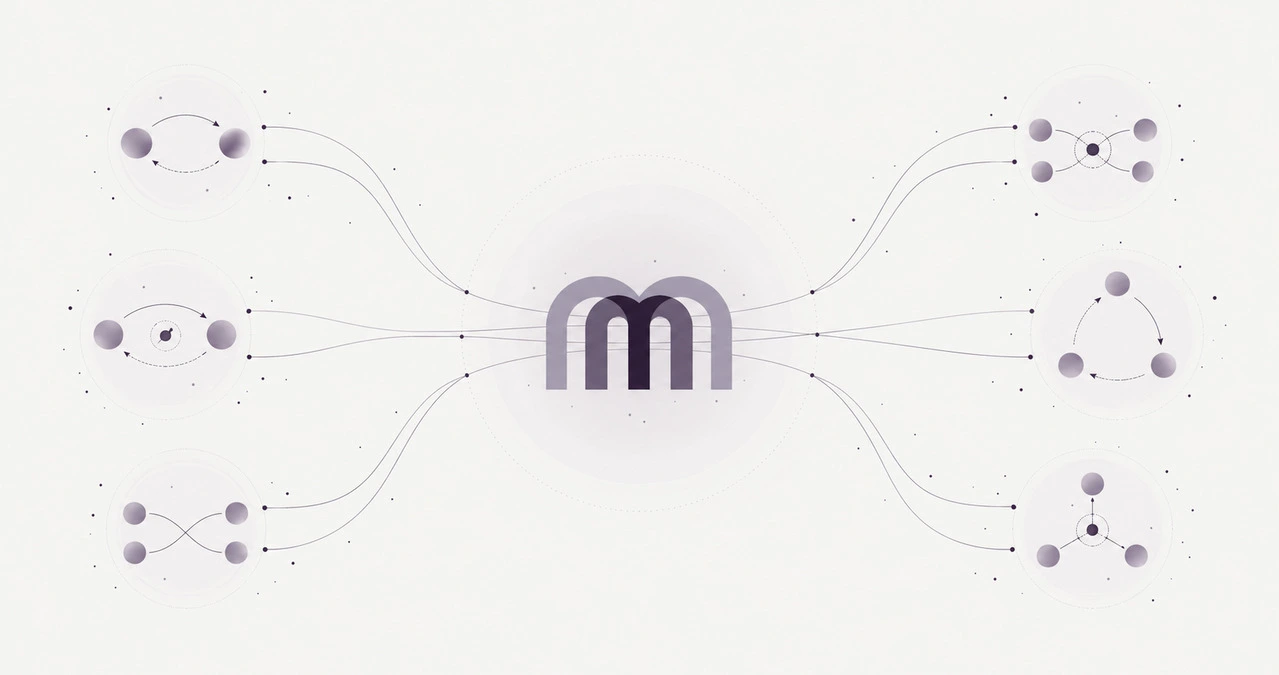
It is this intuition that Metamorfon’s Dialogue Architectures seek to instantiate technically. They are not a range of optional features, but six configurations of the same fundamental operation: organising the productive encounter between distinct artificial intelligences to make their plurality an instrument of thought. The diversity of these architectures is not a comfort of personalisation; it corresponds to a variety of situations in which the friction between competing voices takes different forms — frontal or multilateral, focused or diffuse, fixed-register or adjustable. Each responds to a distinct dialogic question. All share the same philosophical conviction: thought needs debate, and debate needs to be organised to become productive.

The idea that thought is built in dialogue rather than in solitude is not new. It runs through a long Western tradition extending from Plato’s dialogues — where Socrates does not seek to teach what he knows but to provoke in the other the examination they could not conduct alone — to the contemporary phenomenology of intersubjectivity. But it was with a specific philosophical event of the twentieth century that it received its most rigorous formulation, one that makes it operational for understanding what Metamorfon does: the shift from monologism to dialogism.

Monologism, in its paradigmatic form, is what Kant had posited as the very structure of moral reasoning. To verify the validity of a maxim of action, the rational subject must universalise it within the inner forum of their own consciousness: “Can I will that this maxim become a universal law?” The operation is entirely interior. It requires no other, and indeed is wary of others: authentic rationality is guaranteed by its methodical solitude, because others might introduce contingent considerations that would contaminate the universal. Kantian monologism is admirable in its rigour; it makes the rational subject the tribunal of itself. But it carries a constitutive difficulty that the twentieth century never ceased to identify: how can a consciousness verify what it does not see that it does not see? How can a line of reasoning identify its own silent presuppositions? How can a subject step outside the position from which it thinks, in order to examine that position itself?

Jürgen Habermas, in the second half of the twentieth century, formulated the most systematic answer to this difficulty. It is not a matter of abandoning the Kantian demand for universality, but of displacing the locus where it is verified. The validity of a norm, an argument, a thesis cannot be guaranteed by the introspection of a single consciousness; it must be submitted to the effective discussion of a set of participants capable of raising objections, proposing alternatives, and demanding justifications. What Habermas calls discourse ethics rests on this central idea: only that which can survive “the non-coercive force of the better argument” in a speech situation where every voice has equal possibilities of expression carries authentic validity. Rationality is no longer monological; it is communicative. It no longer resides in the inner forum; it inhabits the public space of critical discussion.

This philosophical shift is more profound than it may appear. It changes the very definition of what it means to think correctly. To think correctly, in the Habermasian paradigm, is no longer merely to reason without contradiction; it is to reason while making oneself available to objections. A thesis that has been subjected to no effective contradiction is not thereby false, but it is epistemically incomplete: it has not undergone the test that could have solidified or disqualified it. Positions that unfold within the consciousness of a subject alone, however rigorous, remain in a state where their validity is in suspension — not because it depends on the judgment of others, but because it depends on an operation that solitude makes structurally impossible: the test of resistance.

This idea has a direct consequence for how we interact with large language models. A prolonged dialogue with a single model, however long and nuanced, remains monological in the Habermasian sense. The model deploys its reasoning, proposes surface-level objections, anticipates certain critiques — but it does so from its own position, with its own axioms, without any genuinely external voice coming to resist it. The model’s blind spots remain its blind spots; its structural biases remain invisible to itself. The simulated plurality of an internal debate within a single model is not true plurality: it is a soliloquy in which consciousness plays all the roles. For dialogue to exist in the strong sense, alterity must be effective — another intelligence, differently trained, differently optimised, differently structured, must come to meet the first and oppose what it could not have anticipated.

It is this effective alterity that Metamorfon’s architectures construct.

2. The Productivity of Friction

But Habermasian dialogism, powerful as it is, does not tell the full story of what a debate produces. It describes with rigour the conditions of rational argumentation; it says less about what happens in the friction between positions. To grasp this dimension, we must invoke another tradition, older and in some respects still more powerful: Hegelian dialectics.

Hegel advanced a thesis that may seem abstract but has considerable practical consequences: a concept that has not passed through its own negation remains abstract. By abstract, we should not understand obscure or difficult; we should understand formally present but without effective content. The abstract concept exists in the understanding as an empty figure that can be manipulated without risk, because it has not yet been tested by its contradiction. The concrete concept, by contrast, is what the abstract concept becomes after having integrated its own negation — not by erasing it, but by preserving it as an interior moment. This is what Hegel calls Aufhebung, an operation without exact equivalent in English, variously translated as sublation, supersession, or overcoming. The Aufhebung is simultaneously a suppression (the initial concept is called into question), a preservation (what it carried that was right is retained), and an elevation (the result is qualitatively more consistent than the point of departure).

This structure is not one method among others for conducting a discussion. It is, for Hegel, the very structure of living thought. A thought that unfolds without encountering its own contradiction remains at the level of opinion — a formal position that has not been tested. A thought that encounters its contradiction and flees from it remains at the level of dogma — a closed position that imagines it can survive without confrontation. Only the thought that encounters its contradiction, integrates it, and emerges transformed, accedes to what Hegel calls the concept in the strong sense — no longer the mere representation of a thing, but the thing itself grasped in the totality of its determinations.

To understand what this structure implies in practice, a single example suffices. A concept like freedom, posited directly by a thought that would encounter only positions of agreement, remains abstract: it functions as a hollow word that can be deployed in formulas without meeting any resistance. The same concept, subjected to a critique that exposes its aporias — formal freedom that masks economic constraint, individual freedom that presupposes a collective framework, freedom understood as independence that reveals itself as dependence on other dependencies — is not destroyed by this critique. It is worked. What emerges after the working is not the initial concept saved at the last moment; it is a concept of freedom that has integrated its own negation, that knows what it defines itself against, that no longer takes itself as self-evident. That concept is concrete in the Hegelian sense. It has a consistency the initial concept lacked, because it has survived the test that could have destroyed it.

This Hegelian intuition completes Habermasian dialogism on an essential point. Habermas says how a debate must be conducted to be rational — what the formal conditions are that make argumentation effectively critical. Hegel says what a debate produces when conducted in this way — how thought itself is formed, transformed, and reaches consistencies it could not have achieved alone. Both dimensions are necessary. Without Habermasian procedural rigour, dialectical friction can degenerate into sterile confrontation where each party holds its position without anything happening. Without Hegelian productivity, procedural rigour can produce formal consensuses that are merely the arithmetic average of the opening positions, without any real displacement having occurred.

The practical experience of Metamorfon sessions confirmed the relevance of this dual reference in a way that theory alone could not have anticipated. During the early trials conducted in the course of developing the application, a recurring observation imposed itself: a debate that remains in constructive or convergent mode from start to finish produces a thin convergence, in which models agree on formulations that none would have seriously contested at the outset. The same debate, passing through a critical or refutational phase before returning to a constructive register, produces a qualitatively different convergence — in which the concepts retained are no longer those of the starting point, but those that have survived the test of deconstruction. What emerges is more sharpened, more consistent, more operationally useful than what would have emerged from a path without friction. This empirical observation, made before any explicit theorisation, recovers exactly what Hegel had posited as the structure of living thought: the concept only becomes concrete after having passed through its own negation.

This point is central to understanding what Metamorfon does, and it will be developed for its own sake later in this article. It is enough for now to note that it is this productive dimension of friction — not merely critical in the negative sense, but generative in the strong sense — that distinguishes Metamorfon from a simple model comparator. Comparing several models consists in juxtaposing their independent responses; having several models debate consists in organizing the encounter where their positions work on each other mutually. The first operates by addition; the second operates by sublation.

3. Polyphony as Structure

One final philosophical reference deserves to be invoked to complete this framework, because it adds to the two preceding ones a dimension that escapes them: that of polyphony. Mikhail Bakhtin, in his analyses of the Dostoevskian novel, thematised the idea that living thought is constitutively polyphonic — that is, that it cannot be reduced to a single voice without losing something of its nature. For Bakhtin, the Dostoevskian novel is not the staging by a single narrator of characters who would express his theses; it is a device in which several fully developed consciousnesses coexist without being absorbed into the unity of an overarching viewpoint. Each has its own logic, its internal coherence, its partial truth; none is the instrument of a higher truth that would use them.

This thesis may seem literary; it is in reality philosophical. It says that there are objects of thought — genuinely complex questions, genuinely contested issues — that cannot be grasped from a single voice without being impoverished. The plurality of voices is not for them an obstacle to knowledge; it is its condition. A moral question like that of responsibility, for example, does not allow itself to be understood by applying a single principle to a concrete case; it allows itself to be understood through the coexistence of perspectives — that of the acting subject, that of the victim, that of the witness, that of the judge, that of the accomplice. None says the whole truth; together, they say what none could have said alone. This is what Bakhtin also calls heteroglossia: the coexistence within the same discursive space of voices that are not merely different but typologically distinct, irreducible to a common measure.

This polyphonic dimension completes Habermasian dialogism and Hegelian dialectics. Habermas says how several voices can rationally agree; Hegel says what their friction produces; Bakhtin adds that certain truths only allow themselves to be grasped through the coexistence of voices, without agreement or synthesis — through the simple presence together of irreducible positions. This idea illuminates a fact that advanced use of Metamorfon allows one to observe: certain sessions do not converge, and this non-convergence is not a failure. It is, sometimes, the sign that the question being addressed is one of those that does not allow itself to be reduced to a single answer — that demands several voices to coexist in order to remain true to the complexity of its object.

4. The Two Levels of an Architecture

These three philosophical traditions — Habermasian dialogism, Hegelian dialectics, Bakhtinian polyphony — converge on a shared thesis: living thought demands the effective plurality of voices. They diverge on what this plurality produces (a rational agreement, a conceptual transformation, a coexistence of partial truths), but they agree on its necessity. A thought that deprives itself of plurality deprives itself of the test that would make it fully consistent.

Metamorfon’s Dialogue Architectures are the devices that make this plurality technically operational. They do not merely place several models in presence; they organise the form of their encounter, because not all encounters are equal. A poorly organized encounter can produce sterile juxtaposition, unproductive conflict, or soft consensus. A well-organised encounter produces what each of the three traditions has sought to theorise: a space where thought is tested, transformed, and augmented by what no single voice could have produced alone.

Six architectures are available. They are distinguished according to two levels that must be clearly separated, because they do not operate on the same thing. The first level concerns the dialogic situation — who speaks to whom, in what order. The second concerns the discursive register — with what quality of friction the discussion is conducted. The distinction between these two levels is what makes it possible to understand what Metamorfon permits operationally, and it is also what distinguishes non-adaptive architectures from adaptive ones.

5. The Dialogic Situation: Who Speaks to Whom

The first level concerns the establishment of the situation in which discussion can take place. It can be configured according to two variables: the number of voices taking part in the debate, and the order in which they respond to each other.

The number of voices distinguishes the two-model dialogue from the three-model trilogue. This difference is not merely quantitative. The sociologist Georg Simmel, in his analyses of elementary social forms at the beginning of the twentieth century, had shown that the transition from the dyad to the triad topologically transforms the nature of interactions. In the dyad, each position is largely defined by its difference from the other. Any concession can be read as a victory for the opponent; any distance can be read as a refusal of dialogue. The dyad pushes either towards rupture or towards frontal compromise — there is no third term that would allow the discussion to breathe. In the triad, by contrast, space opens up. Positions no longer define themselves solely in opposition to one other, but in a field with three poles where coalitions are contingent, where concessions no longer carry the same symbolic weight, where the silence of one voice on a point can isolate its interlocutors without disqualifying them.

This topological transformation has concrete effects on what the debate produces. In the two-model dialogue, rhetorical pressure is high: each model must defend its position against a single opponent, which tends to harden formulations and make concessions costly. In the three-model trilogue, rhetorical pressure diffuses: a model can concede a point to one without feeling it has capitulated to the other; intermediate positions can emerge that none of the three would have formulated alone; provisional coalitions form and dissolve as the questions change. The trilogue thus produces dynamics that the dialogue does not — not because the three models play different roles (in Metamorfon, the third model receives exactly the same instructions as the other two: no functional asymmetry is introduced), but because the simple presence of a third voice transforms the geometry of the exchange. What changes is topological, not hierarchical.

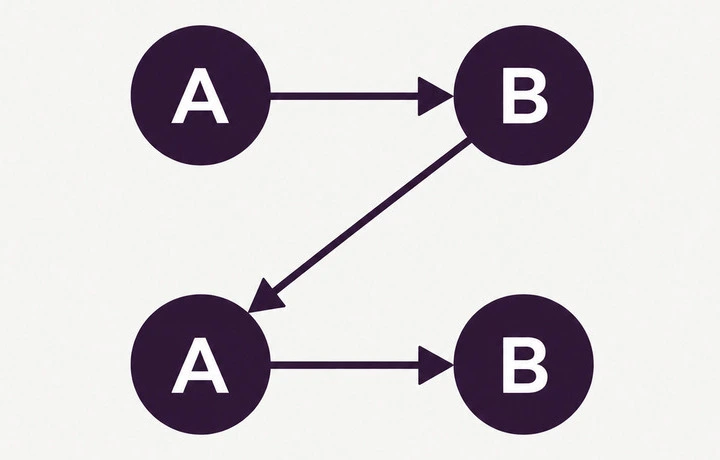
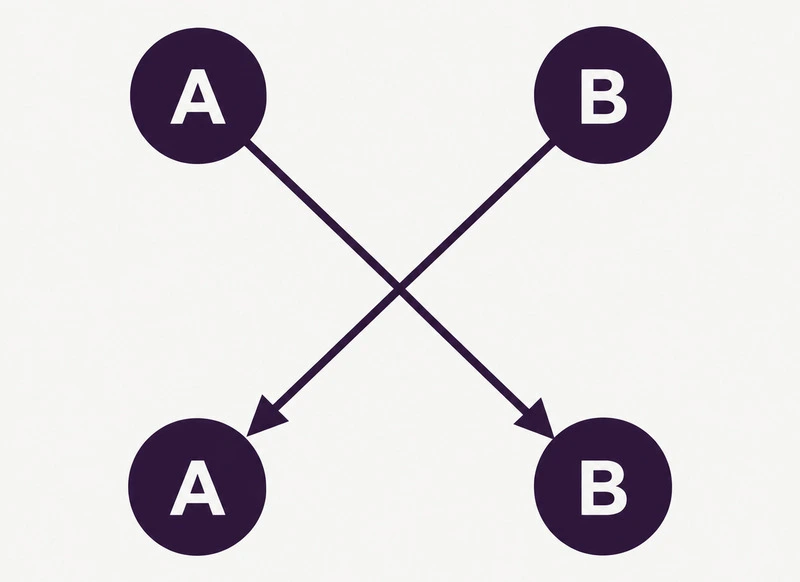
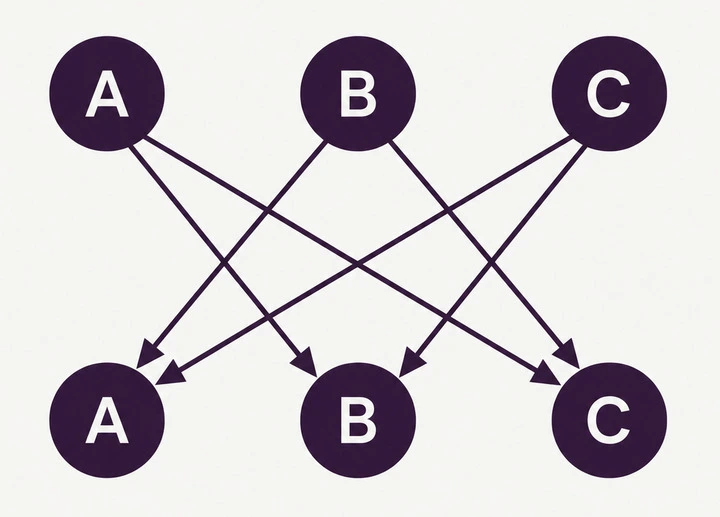
The sequencing distinguishes alternating from cross architectures. In an alternating architecture, models respond one after the other: model A speaks, then model B responds to A, then A responds to B, and so on. Each response has a single precise target — the last intervention of the interlocutor. The debate is concentrated. Arguments unfold in a chain, each link extending or opposing the previous one. In a cross architecture, models speak simultaneously: at each turn, A and B (or A, B and C in the trilogue) each produce their response, taking into account the entirety of previous positions. The debate diffuses. Each response must address several positions at once, which reduces the depth of treatment of each one but increases the richness of their mutual interrelation.

This choice between alternating and cross is not neutral. The alternating architecture is better suited to dialogues where fine argumentative sequencing is valuable — when one wants to follow a chain of reasoning, redirect the debate between each model response, see how each thesis calls forth its antithesis, how each objection mobilises a precise reply. The cross architecture is better suited to situations where the placing in presence of positions matters more than their linear sequencing — when one wants to see how several positions relate to a common problem, without privileging a single argumentative chain. For obvious operational reasons, trilogues are systematically cross in Metamorfon: organising a regular alternation between three voices would raise sequencing questions that simultaneity naturally resolves, and the added value of the third voice manifests precisely in the dynamics of multilateral response that crossing enables.

These two variables — number of voices and sequencing — determine four elementary dialogic situations. They define where the debate takes place, who speaks in it, and according to what logic of response. But they say nothing yet about the quality of the friction that will develop within it. That is what the second level decides.

6. The Discursive Register: With What Quality of Friction

The second level concerns what the models do within the dialogic situation. The same cross trilogue can produce a peaceful and constructive session or a vivid and confrontational one, depending on the discursive register in which the models operate. Five registers are available in Metamorfon, and it is essential to understand them not as five rungs on a single scale of intensity, but as five distinct registers, each with its own logic.

This precision is not pedantic. If one conceives of debate modes as a slider running from “more convergent” to “more critical”, one expects each mode to be simply a stronger or weaker dose of the same thing. That is a convenient but false representation, and it leads to misusing the device. The modes differ not only in their intensity; they differ in what they take as their object and the manner in which they examine it. Understanding this qualitative difference is what allows one to make full use of the adaptive architectures, where the user can modulate the register between turns.

6.1. Convergent Mode

Convergent mode is one of five discursive registers available in Metamorfon’s adaptive architectures. It organises a debate in which models actively seek agreements, develop shared ground, and work to elaborate a foundation of shared positions. This mode is not a diluted discussion; it is a precise operational register, particularly useful when a preceding debate has brought strong divergences to the surface and the user wishes to identify what can nonetheless be stabilised. The characteristic risk of convergent mode is what the social sciences call soft consensus: an agreement reached by erasing nuances that would have deserved to be preserved. That is precisely why this mode is relevant after a critical phase, when the models have already tested their disagreements and can identify what survives the test. Used alone, without a prior critical phase, it tends to produce formal agreements without effective content.

6.2. Constructive Mode

Constructive mode is one of the five discursive registers available in the adaptive architectures. It organises a co-construction in which models deploy a reflection together, exploring its nuances, ramifications, and consequences. It differs from convergent mode in its posture: the aim is no longer merely to agree, but to build — that is, to develop an articulation richer than what any model would have produced alone. Constructive mode accepts that collective elaboration may proceed through fine nuances, specifications, and distinctions, without these being treated as disagreements to be resolved. It is the mode most appropriate for developing a conceptual framework, exploring a problematic, or collectively formulating a complex position.

6.3. Balanced Mode

Balanced mode is the median mode among the five discursive registers. As its name suggests, it is a midpoint: it combines constructiveness and critique. Models build positions together while allowing themselves to raise objections, point to limits, and propose alternatives. This is the mode used by default in the non-adaptive architectures. This central position is not an arithmetic average — it is a particular register that might be characterised as the natural version of an intellectual discussion between interlocutors who respect each other and take their subjects seriously. Balanced mode is generalist in the sense that it is suited to most subjects without special adjustment; it is less constraining for the models than the more polarised modes, which makes it particularly well suited to situations where the user does not wish to impose a strong discursive orientation.

6.4. Critical Mode *

Critical mode is one of the five discursive registers of the adaptive architectures. It organises a debate in which models actively examine each other’s arguments, raise objections, identify weaknesses, and demand justifications. It operates within the framework of the debate — that is, it takes as given the questions the models are addressing and criticises the ways in which those questions are treated. Critical mode is not hostile: it is demanding. It pushes models to formulate their positions with greater precision, to anticipate counter-arguments, and to refine their nuances. It is particularly valuable when a debate tends to drift towards premature consensus, or when the user wants to ensure that the positions retained have genuinely been tested before being adopted.

6.5. Refutational Mode *

Refutational mode is the most radical of the five discursive registers. It is qualitatively distinct from critical mode, and this distinction deserves emphasis. Critical mode operates on arguments within an admitted framework; refutational mode operates on the framework itself. It deconstructs the presuppositions that models held as given, calls into question admitted definitions, interrogates self-evident assumptions. This operation has a precise Socratic lineage: it is what Socrates does to his interlocutors in the Platonic dialogues, not in order to refute their answers (which would be critical), but to shake the foundations that allowed them to answer. Refutational mode is more radical than critical mode because it refuses the self-evidence of the framework within which the debate is held. It is also, consequently, the mode that produces the deepest conceptual displacements — when it works. When it works poorly, it degenerates into sterile confrontation in which models contest each other’s presuppositions without anything being built. Refutational mode is a powerful instrument, all the more productive for being used sparingly and judiciously; it is not the default mode of a productive debate. It is what one invokes when one needs to go back to the roots.

* To users who hesitate to engage these last two modes, for fear of undermining what they have built: recall that contradiction only damages what deserved it. This formulation refers directly to the Hegelian thesis on the productivity of friction. Only fragile constructions need fear critique; solid ones emerge strengthened. What is endangered by critique are positions that held only through lack of testing — those that had never been put to the test, and that collapse as soon as they are called upon to justify themselves. Contradiction thus plays a filtering role: it does not destroy thought; it distinguishes what deserves to be preserved from what held only by habit or inadvertence.

7. Steering a Dialectical Trajectory

It is by understanding the qualitative distinction between these five modes that one can grasp what adaptive architectures genuinely contribute. A non-adaptive architecture organises a debate in a single mode — the balanced mode, which is generalist and has the merit of revealing the “natural” behaviour of the models. An adaptive architecture, by contrast, allows the user to modulate the register across turns — that is, to steer the trajectory of the debate rather than fixing its register once and for all.

This difference is not merely functional. It changes the very nature of what the user can do with the device. In a non-adaptive architecture, the debate is a state — the models debate for a certain period, in a certain register, and the session closes on what has been produced. In an adaptive architecture, the debate is a trajectory — a path whose every step can be designed to produce a particular effect, and whose result depends as much on the order of steps as on their content. The user is no longer simply the subject who poses a question; they become the conductor of an intellectual trajectory, choosing at each turn what the situation requires.

This is where the dual philosophical reference — Habermas and Hegel — takes its full operational meaning. Habermas had described the formal conditions of a rational debate, but had little thematised the temporal dimension of that debate: how one’s relationship to time modifies the quality of discussion. Hegel, on the other hand, had made time the heart of his philosophy. For Hegel, thought is not a state one reaches but a movement one traverses. The abstract concept only becomes concrete by passing through its own negation, and this traversal takes time. It requires moments — a moment in which the position is posited, a moment in which it is tested, a moment in which it is reconfigured by the test. To skip a step is to remain in the abstract. To rush the synthesis is to miss the movement that makes it possible.

This Hegelian observation finds empirical confirmation in the experience of Metamorfon sessions. An observation made from the very first trials conducted during the development of the application marked the design of the device and continues to guide its use: a debate that remains throughout in constructive or convergent mode produces a thin, formal convergence, in which models agree on formulations that have not been tested. What emerges resembles a synthesis, but it is an abstract synthesis — in the strict Hegelian sense. The same debate, passing through a critical or refutational phase before returning to a constructive or convergent register, produces a convergence of an entirely different nature. The concepts that re-emerge after the test are no longer those of the starting point; they have been reworked by critique. What comes out is more sharpened, more consistent, more operationally useful than what would have emerged from a path without friction.

This observation is counter-intuitive. Spontaneously, one imagines that to produce a constructive result, one must conduct the debate in constructive mode. That is the fundamental error. Constructive mode without a prior critical phase produces a hollow construction; critical mode without a return towards the constructive produces a deconstruction without reconstruction. The real fertility lies in the trajectory that combines both: first testing what seems self-evident, deconstructing what appears established, then returning to construction with material that has been reworked. The synthesis that then emerges is not the average of the opening positions; it is what has survived the test, and what survives the test has a consistency nothing else produces.

This observation has a reach extending beyond its practical formulation. It says something about the nature of thought itself. Dialectical friction is not merely a critical instrument — a means of revealing what is weak in arguments. It is also, and perhaps above all, a productive instrument — a means of producing what is strong. An idea that has not been subjected to critique remains at the level of opinion; an idea that has survived critique has become a concept. The work of negation is not destructive; it is formative. This is why Hegel could write, in the preface to the Phenomenology of Spirit, that the life of the spirit is not one that recoils from death and keeps itself pure from destruction, but one that endures death and maintains itself within it. The formulation is striking, but its practical import is concrete: thought only becomes fully alive by accepting to traverse what could destroy it.

For the Metamorfon user, this observation translates into a few practical principles that can transform the use of adaptive architectures. The first is not to yield to the temptation of remaining in constructive or convergent mode, even when the debate seems to be producing agreeable results: those results are often abstract in the strong sense, and they will not hold under demanding use. The second is to plan explicitly, in the design of a session, for phases of critique or refutation — not as obligatory passages but as productive moments, whose function is to test the concepts that must subsequently be consolidated. The third is to pay particular attention to the return towards constructive modes after a critical phase: it is in this return that Hegelian productivity manifests, because it is there that tested concepts can be rebuilt in a form that integrates the traversed ordeal. An ideal trajectory is not a regular succession of modes; it is an orchestration that provides for the phase of positing, the phase of testing, and the phase of reconstruction.

These principles do not apply mechanically. Not all subjects call for a critical-refutational trajectory. Certain questions — particularly exploratory or creative ones — benefit from limited friction. But for high-stakes questions — serious controversies, complex problems, decision-making issues — the trajectory that includes a testing phase produces results of a quality that direct convergence never yields.

8. The Six Situated Architectures

With these two levels clearly distinguished — the dialogic situation on one side, the discursive register on the other — Metamorfon’s six architectures find their natural position. Each corresponds to a specific combination of parameters that determines both the situation and the quality of friction.

8.1. Alternating Dialogue

Alternating Dialogue is the simplest of the six architectures offered by Metamorfon. It brings two models together to respond one after the other, in balanced mode. It is the architecture best suited to discussions where fine argumentative sequencing is valuable and where the user does not wish to steer the discursive trajectory. It is particularly well adapted to exploratory or perspective-building dialogues, where the alternating rhythm allows each model to respond precisely to the preceding intervention.

8.2. Adaptive Alternating Dialogue

Adaptive Alternating Dialogue brings two models together to respond one after the other, as in Alternating Dialogue, but adds a decisive dimension: the ability for the user to modulate the discursive register after each individual response, among the five available modes (from convergent to refutational). This granularity is the finest of all six architectures: the user can choose, between A’s response and B’s response, which mode to apply. This fineness authorises a singularity that exists nowhere else among the six architectures: the possibility of assigning distinct roles to the two models within a session, by applying different modes to them within a single turn. One can thus have, for example, a model in constructive mode developing a thesis while the other, in refutational mode, examines it. This asymmetry of register does not change the general instructions (which remain the same); it introduces a functional asymmetry that transforms the device, making it possible to modulate the inequality of instructions between models. This is the only architecture that permits this, and it is what makes it arguably the most singular of the six.

8.3. Cross Dialogue

Cross Dialogue brings two models together to respond simultaneously, in balanced mode (the median mode, both constructive and critical). At each turn, A and B produce their response taking into account the entirety of the other’s preceding position. Simultaneity changes the dynamic: each response must account for the whole of the preceding position, which produces more synthetic and less sequentially chained responses. This architecture is particularly suited to situations where the placing in presence of positions matters more than their linear sequencing — when one wants to see how two perspectives relate to the same problem.

8.4. Adaptive Cross Dialogue

Adaptive Cross Dialogue brings two models together to respond simultaneously at each turn, as in Cross Dialogue, but adds the ability for the user to modulate the discursive register between turns, among the five available modes (from convergent to refutational). Modulation occurs between turns, and not within a turn as in Adaptive Alternating Dialogue. This is the architecture best suited to intellectual trajectories structured in broad phases: a constructive phase, then a critical phase, then a constructive return. Granularity is coarser than in Adaptive Alternating Dialogue, but it is sufficient for steering a substantial dialectical trajectory.

8.5. Cross Trilogue

Cross Trilogue brings three models together to respond mutually at each turn, in balanced mode (the median mode, both constructive and critical). The third model receives exactly the same instructions as the other two: no functional asymmetry is introduced. But the simple presence of the third voice transforms the topology of the debate — as Georg Simmel had theorised with regard to the transition from dyad to triad — and produces dynamics that the two-model dialogue does not: intermediate positions, provisional coalitions, third-party positions that can isolate or rally. This architecture is particularly suited to complex questions where the plurality of perspectives is valuable in itself, without any need to modulate the discursive register.

8.6. Adaptive Cross Trilogue

Adaptive Cross Trilogue brings three models together to respond mutually at each turn, as in Cross Trilogue, and adds the ability for the user to modulate the discursive register between turns, among the five available modes (from convergent to refutational). This is the most complete of the six architectures, the one that simultaneously mobilises the three philosophical traditions invoked in this article: Habermasian dialogism (through the plurality of voices submitted to critical discussion), Hegelian dialectics (through the ability to modulate the register between turns to produce a productive path), and Bakhtinian polyphony (through the coexistence of three voices that maintains an irreducible heterogeneity). For the highest-stakes questions, this is probably the architecture that produces the richest results — at a computational cost proportional to the richness of the device.

9. Dialogue Architectures and Analysis Modes

Dialogue Architectures construct the conditions of productive friction. They organise who speaks to whom, in what order, and with what quality of discussion. But their work stops where that of the analysis modes begins: once the session has been conducted, what it has produced must be read — that is, interpreted, structured, and evaluated from different angles. Metamorfon’s analysis modes (Meta-analysis, Integrative Synthesis, Emergence Analysis, Tension Mapping, Critical Archaeology, Horizon of Possibilities, Argumentative Evaluation) play this role: they are the instruments for reading what the architectures have produced. Where architectures build, analysis modes interpret.

This division of labour reflects a deep philosophical distinction, which can be formulated as follows: producing thought and reading thought are two distinct operations. The first demands devices that make friction between intelligences possible; the second demands analytical frameworks that allow one to grasp what that friction has effectively produced. It is in the combination of the two that Metamorfon finds its full power.

This combination refers back to a final philosophical thesis that can serve as a point of horizon. If living thought demands the effective plurality of voices (as Habermas, Hegel, and Bakhtin each demonstrated in their own way), then thinking well supposes two inseparable operations: organising the productive encounter between competing voices, then reading what that encounter has produced. The first operation is dialogic; the second is analytical. Both participate in the same gesture: extracting from plurality what no single voice alone could say. It is this gesture, in its double dimension, that Metamorfon seeks to instrumentalise. Architectures are the instrument of the first moment; analysis modes are the instrument of the second. Together, they sketch what a practice of thought might be that pursues what twentieth-century philosophy demonstrated: that rationality is a collective operation, and that collectivity is a condition of thought rather than an obstacle to it.

Try Metamorfon with a 14-day free trial — no commitment required.

Free Trial

€0

14 days free trial (card required)
Automatically converts to monthly billing after the trial
Cancel anytime