
Features
1. Dialogue Architectures
2. Debate Modes
3. Analysis Modes
4. Control, Transparency & Portability
1. Dialogue Architectures
Six strategies structure the way AI models exchange — from Alternating Dialogue to Adaptive Cross Trilogue. Read more about the specificities of each architecture in our dedicated page.

Alternating Dialogue
One response at a time — first model A, then model B. The user can intervene after each individual response and generate an analysis of the exchange via a third-party model after each complete turn.
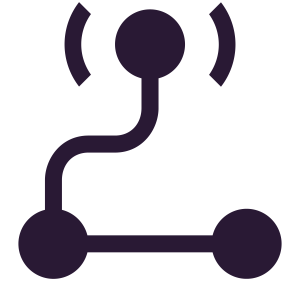
Adaptive Alternating Dialogue
One response at a time — A then B. The user sets the debate mode after each individual response — 5 modes available, from convergent to refutational — and can generate an analysis of the exchange after each complete turn; distinct roles can be assigned to each model.

Cross Dialogue
At each turn, both models respond simultaneously. The user can intervene after each turn and generate an analysis of the exchange via a third-party model.
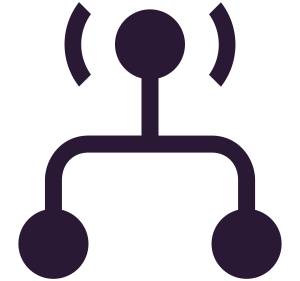
Adaptive Cross Dialogue
At each turn, both models respond simultaneously. The user sets the debate mode between each turn — 5 modes available, from Convergent to Refutational — and can generate an analysis of the exchange via a third-party model.

Cross Trilogue
At each turn, three models respond to one another — third positions, coalitions and arbitrations emerge naturally. The user can intervene after each turn and generate an analysis of the exchange via a third-party model.
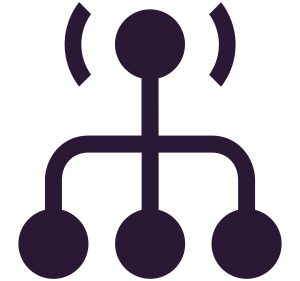
Adaptive Cross Trilogue
At each turn, three models respond to one another. The user sets the debate mode between each turn — 5 modes available, from Convergent to Refutational — and can generate an analysis of the exchange via a third-party model.
2. Debate Modes
Five modes are available in all adaptive strategies. They define how models engage with each other — from shared ground-building to full deconstruction. Interaction depth is calculated in real time by a third-party LLM judge.

Convergent
Search for agreements and developing shared ground. Models reinforce common positions.

Constructive
Co-construction with exploration of nuances. Models build on each other’s contributions.

Balanced
Moderate debate, both constructive and critical. A middle ground between convergence and confrontation.

Critical
Direct, reasoned critique within a defined framework. Models challenge each other’s positions.

Refutational
Deconstruction of frameworks and presuppositions; meta-analysis of discourse.
Independently of these five modes, focus mode suspends, for one turn, the requirement for models to respond to one another and the active debate mode: each model addresses your question without the mediation of the others.
Learn more
3. Analysis Modes
Eight analysis modes are available across all strategies. Each applies a different reading framework to the dialogue. Analysis is performed by a dedicated third-party model. Model reasoning is displayed throughout.

Meta-Analysis
What structures the exchanges — axioms, epistemic styles, biases, and implicit frameworks that shaped the debate.

Integrative Synthesis
What was said — agreements, disagreements, and how the models’ positions evolved across turns.

Emergence Analysis
What was built — co-constructed ideas, semantic shifts, and concepts that emerged through dialogue rather than being brought into it.
Tension Mapping
What resists — persistent divergences, unresolved contradictions, and points where the models could not converge.

Critical Archaeology
What made this particular debate possible — the wording of the question, vocabulary, assumptions, and exclusions that set the boundaries of the exchange.

Horizon of Possibilities
What became thinkable through the debate without being explicitly formulated — implicit directions, unexplored angles, and new questions opened by the exchange.
Argumentative Evaluation
How each model reasoned — quality of inferences, treatment of objections, and falsifiability of positions. One of two normative modes, alongside Source Verification.

Source Verification
The strength of the factual support — cross-checked attributions, verified figures, and untraceable references flagged. This mode checks verifiable claims against external web sources.
4. Control, Transparency & Portability
Every parameter visible. Every session manageable at depth. Sessions that travel: every dialogue is exportable, importable, and shareable.
Real-time Metrics
Tokens (in, out, total) and costs are calculated and displayed in real time at every response, summary, synthesis, and scoring event.
Interaction Depth Scoring
In adaptive strategies, a third-party LLM judge calculates interaction depth between models : argument responsiveness, cross-referencing.
Temperature Control
Adjust the temperature of each model independently — a granular parameter in order to calibrate creative range vs. precision.
Web Access
Enable web access per session when models need to consult live sources. Available as an advanced parameter.
Context Summaries
A lightweight third-party model generates periodic summaries to preserve and optimize context across long sessions.
Reasoning Display
For models that expose their reasoning process, the reasoning trace is displayed in the session view.
Export Formats
Export any session in three formats: Markdown (.md) — lightweight, portable, readable in any text editor, docx, JSON.
Import & Resume
Import any JSON Snapshot to resume a session exactly where it left off (session state, including parameters and history).
.
Languages
Metamorfon is available in 11 languages: English, French, Spanish, German, Italian, Dutch, Portuguese, Danish, Swedish, Norwegian, Polish.
Try Metamorfon with a 14-day free trial — no commitment required.
Free Trial — 14 days
€0 today, then €30/month incl. VAT
14 days free trial (card required)
Automatically converts to monthly billing after the trial
Cancel anytime